
What Are Rules of Origin?
Rules of origin determine a product’s economic nationality for customs purposes. Additionally, this matters because the origin sets import duty, eligibility for trade agreements, and how goods are labelled. Origin isn’t always the same as where the goods were shipped, so Proof of origin matters in practice.
Why Rules of Origin Matter
Three things depend directly on getting origin right:
- Import duty. The rate you pay can change significantly depending on where your goods are deemed to originate.
- Trade statistics. Governments use origin data to compile accurate trade figures.
- Labelling. “Made in…” claims are governed by origin rules, not just where a product was packaged or shipped.
Businesses can request an advance ruling from HMRC to confirm in advance which rules of origin will apply to a specific import, which is worth doing for high-value or recurring shipments.
Preferential vs Non-Preferential Rules of Origin
There are two types of rules of origin, and they serve different purposes.
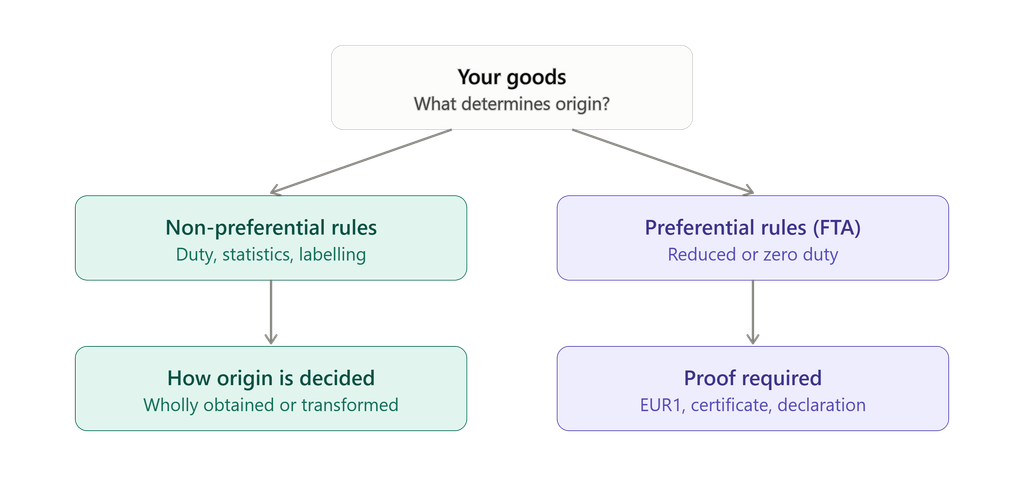
Default non-preferential rules of origin apply for duty calculation, trade statistics, and ‘made in’ labelling.
Goods fall into one of two categories.
- Wholly obtained: produced entirely in one country, with no imported materials — natural products, for example.
- Substantial transformation: if goods were processed in more than one country, origin goes to the last country where a substantial, economically justified transformation took place, resulting in a genuinely new product.
Customs authorities decide “substantial transformation” using one of three tests: how much local versus foreign value went into the product, whether its tariff classification changed between raw material and finished product, or whether specific required manufacturing processes took place there.
Preferential rules of origin apply within free trade agreements (FTAs). Proof of origin confirms your goods meet the specific origin rules of an FTA. Additionally, they can qualify for reduced or zero import duty. Each FTA has its own rules. A product must be checked against the agreement you’re using. There is no universal standard. For goods with many components, a Bill of Materials is often needed to check compliance.
How to Prove Origin: Certificates and Declarations
This is the part most businesses get stuck on. Here’s what’s actually used to prove origin:
- Certificate of origin: a document, often stamped by a Chamber of Commerce, confirming where goods were produced.
- EUR1 / EUR-MED movement certificates: used specifically to claim preferential duty rates under certain trade agreements.
- Invoice declarations: a statement made by the exporter directly on a commercial invoice, rather than a separate certificate.
- Supplier declarations: evidence from a supplier confirming their goods meet origin requirements, used when you’re relying on components from elsewhere in your supply chain.
- Approved Exporter status: a status granted by customs that allows a business to self-certify origin, rather than obtaining a certificate for every shipment.
Keep this evidence on file. If HMRC or an equivalent authority later queries an origin claim, the burden is on the business to produce the supporting proof.
Key Rules Worth Knowing
A handful of additional rules shape how origin claims actually work in practice:
- General tolerance (de minimis) rule: allows a small percentage of non-originating materials while still qualifying for preferential origin. Always check this rule first, before the agreement’s specific product rules.
- Principle of territoriality: manufacturing generally has to happen without interruption in the country claiming origin.
- Direct transport rule: goods usually need to be shipped directly to their destination, without significant stops in other countries, unless those stops are under customs supervision.
- No-drawback rule: you can’t claim a duty refund on imported components that are later used in finished goods exported under a preferential origin claim.
- Cumulation: lets materials from certain partner countries count as if they originated in the exporting country. There are several types — bilateral, diagonal, regional and full — and which applies depends on the agreement.
- Accessories, spare parts and tools: generally take the same origin as the main product, if shipped together with it.
- Anti-circumvention rules: prevent processing carried out purely to get around origin requirements rather than for a genuine manufacturing reason.
Rules of Origin After Brexit
Origin has become significantly more important for UK businesses since Brexit, because the UK now runs its own, independent trade policy rather than operating under the EU’s.
For UK traders, two things matter most.
They are Proof of origin and timely compliance.
- The UK-EU Trade and Cooperation Agreement (TCA) allows full bilateral cumulation between the UK and EU. In practice, this means materials and processing from the EU can count as UK origin for goods you export to the EU, and vice versa.
- The UK Generalised Scheme of Preferences (GSP) gives preferential access to imports from developing countries, through three tiers: a quota-free, nil-rate tier for the least developed countries, a general framework with reduced rates for lower-income countries, and an enhanced framework with nil rates for countries meeting certain human rights, environmental and governance standards. Exporters in GSP countries can self-certify origin under Registered Exporter (REX) status.
As the UK continues to negotiate its own FTAs, cumulation rules will increasingly determine how much EU-origin content can still count toward UK-origin claims — worth watching if your supply chain runs through both.
Written by Customs Directory, a practising UK customs consultant. For related guidance, see our Customs Clearance UK: Import & Export Procedures, Documents & Costs and Returned Goods Relief for Repaired Goods guides.
Customs Clearance UK: Import & Export Procedures, Documents & Costs (2026 Guide)
Returned Goods Relief for Repaired Goods
What is a certificate of origin?
A document confirming the country in which goods were produced, often issued or stamped by a Chamber of Commerce.
What’s the difference between preferential and non-preferential rules of origin?
Non-preferential rules apply by default for duty, statistics and labelling. Preferential rules apply specifically within free trade agreements, and can reduce or remove import duty if the goods qualify.
How do I get an EUR1 certificate?
An EUR1 is issued to confirm origin for the purposes of claiming preferential duty rates under specific trade agreements — check with your local Chamber of Commerce or customs authority for the application process relevant to your trade route.
What is cumulation?
A rule that allows materials from certain partner countries to be treated as if they originated in the exporting country, which can help goods meet origin requirements they wouldn’t otherwise satisfy.
Can I check in advance how my goods will be classified for origin purposes?
Yes — HMRC offers advance rulings, which confirm how the rules of origin will apply to a specific product before you import or export it.
Comments