
What Is Customs Clearance in the UK?
Customs clearance in the UK is the formal process of declaring goods to HM Revenue & Customs (HMRC) when they are imported into or exported from the United Kingdom. It ensures that:
- Correct customs duties are calculated
- Import VAT is accounted for (including Postponed VAT Accounting)
- Goods comply with UK import/export regulations
- All required documents are submitted via the Customs Declaration Service (CDS)
Since Brexit, customs clearance is required for UK–EU trade as well as trade with non-EU countries. This has significantly increased the need for accurate declarations and professional customs support.
Official HMRC guidance:
Customs Declaration Service (CDS): https://www.gov.uk/government/collections/customs-declaration-service
When Is Customs Clearance Required in the UK?
Customs clearance is required when goods:
- Are imported into the UK from EU or non-EU countries
- Are exported from the UK to international destinations
- Move under special procedures (e.g., Inward Processing, Transit)
- Require licences, SPS controls, or regulatory certification
- Are subject to customs controls, quotas, or trade defence measures
Failure to complete clearance correctly can result in:
- Delays at ports or airports
- Financial penalties
- Seizure or inspection of goods
- Post-clearance audits by HMRC
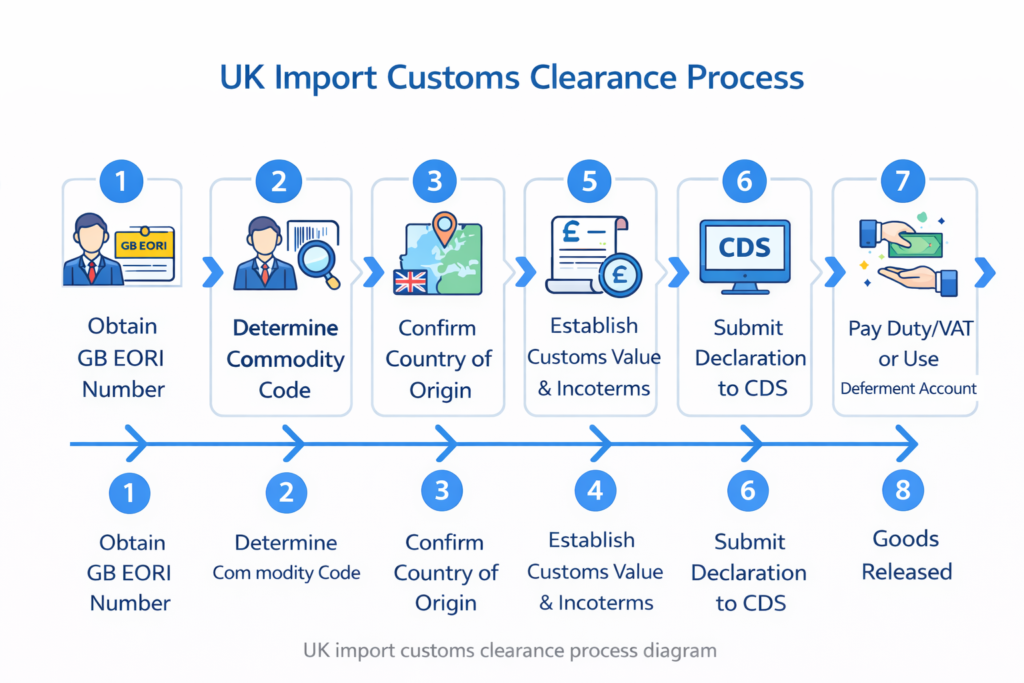
Step-by-Step: UK Import Customs Clearance Process
This section is important for ranking — Google prefers structured steps.
- Obtain a GB EORI number
- Determine the correct commodity (HS) code
- Confirm the country of origin
- Establish customs value and Incoterms
- Calculate duty and VAT
- Submit declaration through CDS
- Pay duty/VAT or use deferment account
- Goods are released
Errors in classification or valuation are the most common causes of delays.
UK Export Customs Clearance Process
For exports, businesses must:
- Submit an export declaration via CDS
- Provide commercial documentation
- Ensure compliance with export controls
- Obtain proof of export (important for VAT zero-rating)
Exporters must also check whether the destination country requires additional documents such as certificates of origin or product conformity certificates.
Documents Required for UK Customs Clearance
Accurate documentation is essential. Common documents include:
- Commercial invoice
- Packing list
- Bill of lading or Air Waybill
- EORI number
- Commodity code
- Preference statement (if applicable)
- Import/export licence (if controlled goods)
- CHED documents (for SPS goods)
Incomplete documentation is one of the leading causes of border delays.
How Much Does Customs Clearance Cost in the UK?
This section improves ranking significantly.
Customs clearance costs typically include:
- Import duty (based on commodity code and origin)
- Import VAT (20% standard rate unless reduced)
- Customs agent clearance fees (£25–£75 per entry on average)
- Storage or demurrage charges (if delayed)
- Inspection or compliance fees
Using a professional UK customs agent often reduces overall costs by preventing classification errors and penalties.
How Long Does Customs Clearance Take in the UK?
- Most standard shipments clear within a few hours
- Border inspections can delay shipments 24–72 hours
- Incorrect documentation can cause extended delays
Electronic declarations via CDS have improved processing times, but accuracy remains critical.
Why Use a UK Customs Agent?
While traders can submit declarations directly, many appoint customs agents due to:
- Complexity of CDS requirements
- Tariff classification challenges
- Origin and preference rules
- VAT accounting procedures
- Risk of HMRC penalties
- Working with experienced customs agents in the UK can help exporters avoid delays at ports, airports, and borders while maintaining full regulatory compliance.
Professional agents:
- Submit compliant declarations
- Advise on customs procedures (e.g., Inward Processing)
- Manage deferment accounts
- Reduce compliance risk
- explained/https://customsdirectory.com/customs-clearance-uk-import-export-procedures-explained/
Customs training providers directory
CDS Post-Entry Amendments in the UK: Compliance, Duty Thresholds & HMRC Rules