
The “Hidden” Logic of Living Spaces: 5 Surprising Truths About How the Customs Classifies Your Furniture
1. The “I Know It When I See It” Fallacy
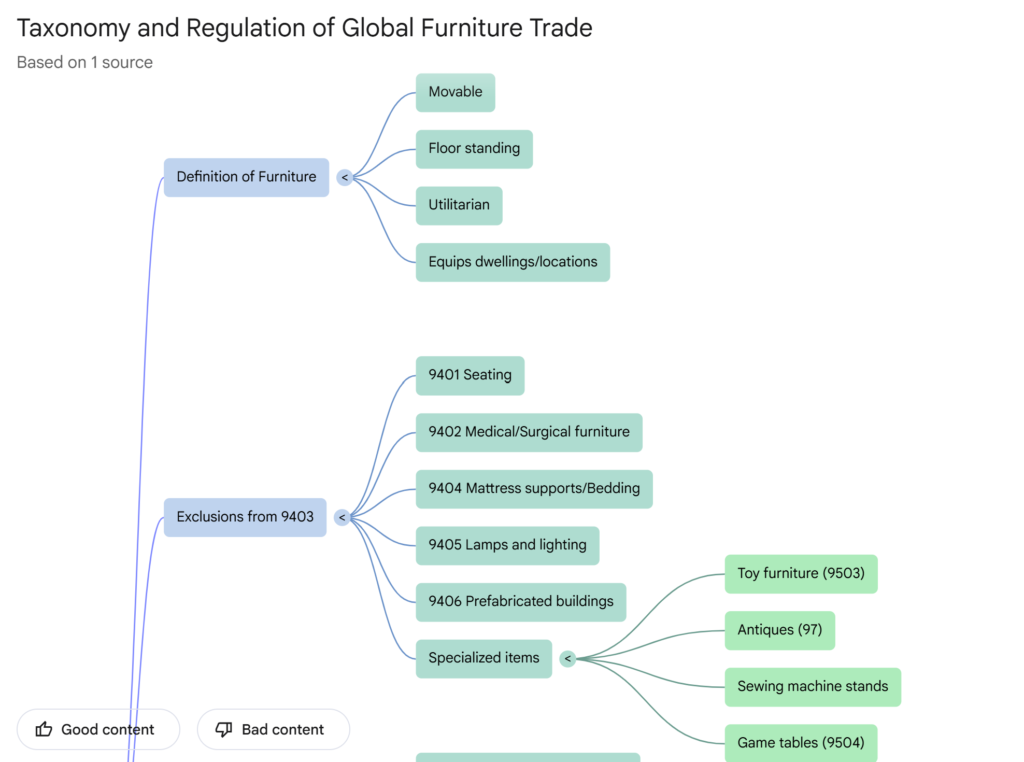
To satisfy the government’s definition of furniture, an object must generally meet four technical pillars:
- Movable: It is non-permanent (though this includes seats bolted into planes or Murphy beds).
- Floor-standing: It must typically support itself on the ground.
- Utilitarian: It provides a work surface, storage, or a functional purpose.
- Equips a Dwelling for Human Use: It must be intended to outfit a space for people.
There is, however, a clever technical exception to the “floor-standing” rule: Unit Furniture. Modular items designed to be hung, fixed to a wall, or stacked one on top of the other (like a tool chest sitting atop a wheeled cabinet) retain their furniture status despite not touching the floor directly. This “unit” logic is what allows modular systems to bypass the material-based classifications that trap other household goods.
2. Your Dog’s Sofa Isn’t Actually Furniture
You might invest in a miniature, upholstered mahogany sofa for your terrier, but to a National Import Specialist, that item is legally indistinguishable from a wooden crate. The “human use” requirement is the ultimate regulatory gatekeeper of Chapter 94.
Because the Customs defines furniture as equipping a place for “use by people,” items specifically designed for animals fail the test. While a standard sofa is classified as furniture, a “pet sofa” is stripped of its status and classified by its constituent material—for example, as “Other articles of wood” under Heading 4421.
“Furniture… equips a dwelling or other place for use by people.”
In trade compliance, classification is driven by the identity of the user, not the utility of the object. Even if it looks and functions like a sofa, its lack of a human occupant changes its legal DNA.
3. The “Play Value” Paradox: Why an Easel Isn’t a Toy
When importing children’s goods, a jurisdictional tug-of-war exists between Heading 9503 (Toys) and Heading 9403 (Furniture). Importers often mistake a child’s easel for a toy, but CBP relies on a technical concept called “manipulative play value.”
To be classified as a toy, an item must be principally designed for amusement. Customs has established that activities like drawing, writing, coloring, or painting do not constitute “significant manipulative play value.” Therefore, a floor-standing easel is furniture because its primary utility is providing a work surface. This distinction is vital for strategists: a toy classification (Heading 9503) triggers a different regulatory regime, including stringent Consumer Product Safety Commission (CPSC) standards, whereas furniture enters under a completely different set of duty and safety requirements.
4. The 1,375% Death Blow: When a Mattress Becomes a Financial Liability
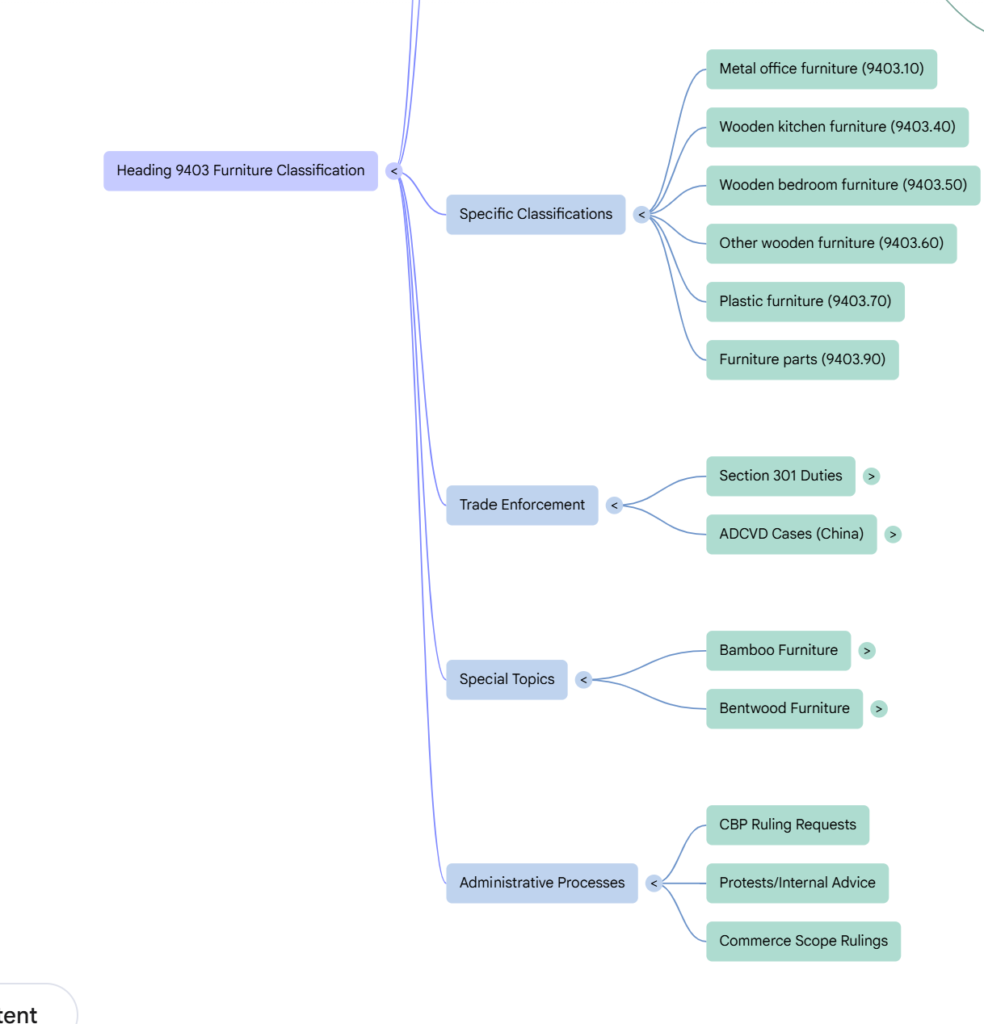
Classification is rarely an academic exercise; it is frequently a matter of corporate survival. Nowhere is this more “ugly” than in the realm of Anti-Dumping and Countervailing Duties (ADCVD).
The most extreme case involves mattresses of Chinese origin, which can carry a staggering anti-dumping rate of 1,375%. For the unwary strategist, the risk is no longer confined to China. This duty “contagion” has recently expanded to seven additional countries, proving that simply moving production out of China isn’t a guaranteed escape from massive tax liabilities.
Furthermore, the “Scope” of these duties is aggressively broad. If you import wooden cabinet doors or drawers from China and perform minor processing or assembly in a third country like Vietnam or Cambodia, they often remain “in scope” for Chinese duties. As National Import Specialist Seth Mazze warns, the financial fallout of a miscalculation here is terminal:
“An importer doesn’t want to make a mistake… because it would be very ugly.”
5. The Super-Grass: Why Your “Wood” Furniture is Actually a Giant Grass
As the industry pivots toward “Green Trade,” bamboo has emerged as a staple material. However, from a regulatory standpoint, your bamboo dining table isn’t wood—it’s a highly processed grass.
Moso Bamboo serves as the industry standard, and its botanical profile is staggering:
- Rapid Growth: It can grow 47 inches in a single day and reach maturity in just five years.
- Rhizome Regrowth: It regrows from the root (rhizome) without needing to be replanted, making it a “super-renewable.”
- Carbon Sequestration: It can sequester up to 70% more carbon per year than a hardwood forest of the same size.
Despite these credentials, the “Green” narrative is complicated by chemistry. The manufacturing process involves boiling strips in boric acid or lime to remove sugars, followed by heat-pressing them with adhesives. This often introduces urea formaldehyde and other volatile organic compounds (VOCs) into the product, creating a technical conflict between the plant’s sustainability and the finished board’s chemical footprint.
6. The “Push” Rule: How Chapter 94 Wins the Tie-Breaker
The Harmonized Tariff Schedule is often a battlefield of competing chapters. To resolve these conflicts, “Push Rules” (such as Note 2X for Chapter 39 or Note 1K for Stone/Ceramics) act as the final word.
When an item meets the definition of furniture, Chapter 94 “pushes” other material-based chapters away. Consider the plastic window shelf:
- It could technically fall under “Other articles of plastic” (Chapter 39).
- However, because it functions as a shelf and meets the Heading 9403 criteria, Chapter 94 overrides Chapter 39.
In the eyes of Customs, specificity is the ultimate weapon. A “Furniture” description is legally more specific than an “Article of Plastic” or “Article of Stone.” This ensures that functional living objects stay grouped together, regardless of whether they are made of resin, marble, or grass.
7. Conclusion: The Blueprint of Compliance
Navigating the architecture of furniture classification requires looking beyond the veneer. What appears to be a “softball pitch” classification can quickly devolve into a complex ruling request involving ADCVD scopes, botanical chemistry, and “human use” hurdles.
In the world of global trade, a product’s true blueprint is written in the law, not the design studio. The next time you walk through your office, ask yourself: If you flipped your desk upside down, would its classification still stand, or is there a 1,000% duty hiding in the grain?NotebookLM can be inaccurate; please double check its responses.
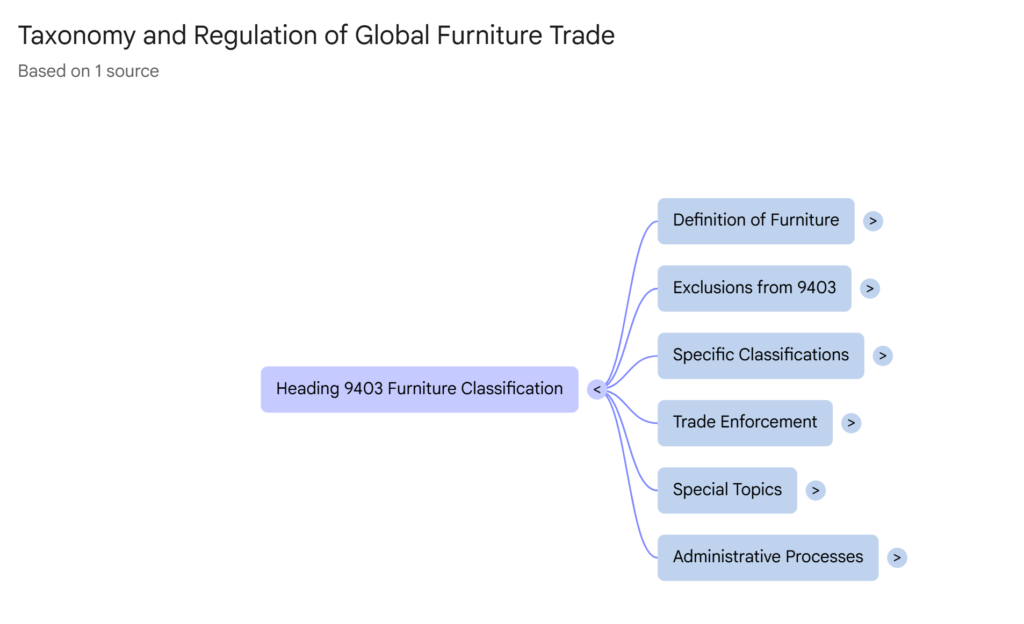
Heading 9403 – Other furniture and parts thereof
Why this matters
A product that seems straightforward from a commercial point of view may carry major trade remedy risk. Classification, origin analysis, and scope review need to work together.
For a detailed overview of procedures and documentation, see our UK customs clearance guide.
The Real Lesson: Customs Looks at Legal Character, Not Retail Description
The hidden logic of furniture classification is that customs law focuses on function, intended user, legal notes, and heading structure.
That is why:
- a pet sofa may not be furniture,
- a child’s easel may be furniture rather than a toy,
- a wall shelf may still be furniture,
- and a material-based heading can be displaced when Chapter 94 applies.
For importers, the safest approach is to assess:
- the product’s intended use,
- who it is designed for,
- whether Chapter 94 applies,
- whether chapter notes exclude other headings,
- and whether AD/CVD scope issues may arise.
Final Thoughts
Furniture classification is one of those customs areas that looks simple until it is not.
A product can appear obvious to a buyer, seller, or designer and still be classified very differently by CBP. The gap between commercial language and legal classification is where many mistakes happen.
If you import furniture, modular storage, pet products, children’s furnishings, or wooden components, it is worth checking the tariff heading, the chapter notes, relevant CBP rulings, and any possible AD/CVD scope before shipment. That work is far cheaper than correcting a mistake after entry.
Businesses looking for professional support can browse our UK Customs Agents directory to compare verified brokers.
Comments