
Understanding tariff classification can be challenging, especially when products are imported in different forms—assembled, unassembled, or as separate components. This real-world example involving a metal and glass cocktail table demonstrates how customs authorities approach classification and duty treatment under the Harmonized System.
Product Overview(Customs Classifies Furniture)
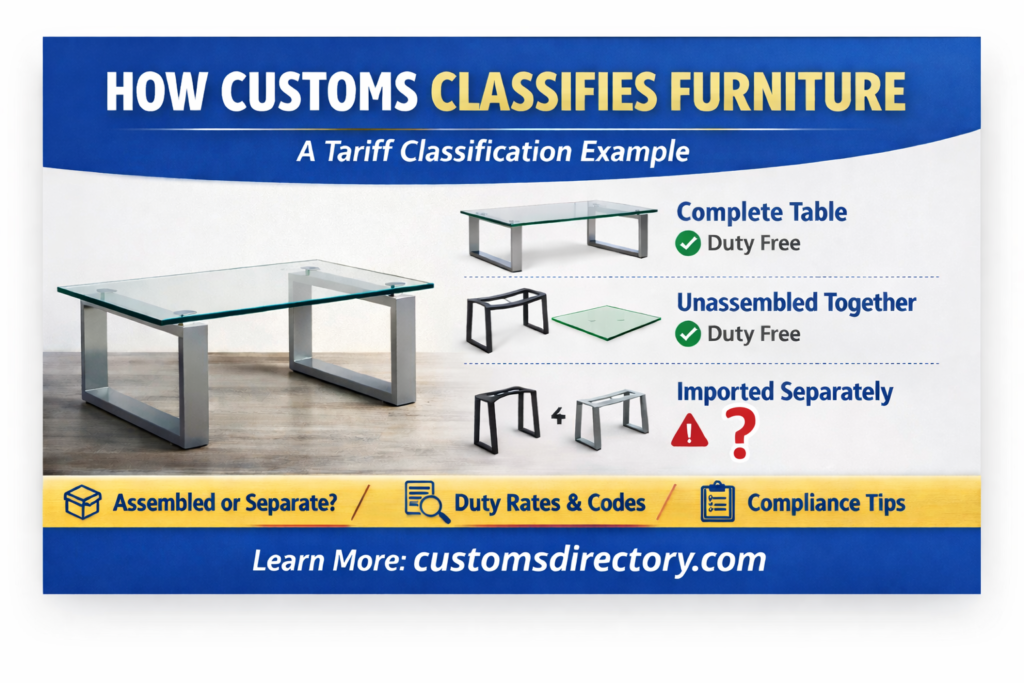
The item under review is a bridge cocktail table intended for household use. It consists of:
- A metal table base
- A clear glass table top
- 8 mm thick
- Edge-worked (finished edges)
The importer requested tariff classifications for three different import scenarios:
- The complete, assembled table
- The table top and base imported together but unassembled
- The table top and base imported separately
This distinction is critical, as classification can change depending on how goods are presented at import.
Customs Clearance UK: Import & Export Procedures, Documents & Costs (2026 Guide)
Classification of the Complete Table
When the cocktail table is imported as a complete item, it is classified as furniture.
- HS/HTSUS Code: 9403208000
- Description: Other metal furniture; household
- Duty Rate: Free
Because the essential character of the product is a household table with a metal structure, it falls clearly under Chapter 94 (Furniture).
Unassembled but Imported Together
When the metal base and glass top are imported together in the same quantities, even if unassembled, customs treats them as a complete article under the General Rules of Interpretation (GIRs).
- HS/HTSUS Code: 9403208000
- Duty Rate: Free
This reflects the principle that goods presented together and intended to form a complete article are classified as if assembled.
Components Imported Separately
When the components are imported separately, each part must be classified on its own merits.
Metal Table Base
- HS/HTSUS Code: 9403208000
- Description: Other metal furniture; household
- Duty Rate: Free
The metal base retains its identity as furniture, even when imported alone.
Glass Table Top
- HS/HTSUS Code: 7006009000
- Description: Worked glass (edge-worked), not framed or fitted
Because the glass top is worked (edge-finished) and imported separately, it no longer qualifies as furniture. Instead, it is classified under Chapter 70 as processed glass.
Key Learning Points for Importers
This example highlights several important customs principles:
- Import condition matters: Assembled, unassembled, or separate imports can lead to different classifications.
- Essential character is key: Goods imported together may be classified as a complete article.
- Components can attract duty: Separating components may increase duty exposure, as seen with the glass top.
- Consulting with a customs agent avoid disputes and delays at import.
- Link to reputable customs agents
Final Thought
Tariff classification is not just about what a product is, but how and in what form it is imported. Strategic planning around shipment structure can have a direct impact on duty costs and compliance outcomes.
If you regularly import furniture, kits, or mixed-material goods, obtaining a classification ruling in advance can save both time and money.
Visit customs agents listing Click Here
Taxation and Customs Union Click Here
❓ Frequently Asked Questions (FAQ)
What is customs classification for furniture?
Customs classification for furniture is the process of assigning the correct HS or tariff code based on the product’s material, function, and how it is imported.
Does it matter if furniture is imported assembled or unassembled?
Yes. Furniture imported assembled or unassembled together is usually classified as a complete item, while components imported separately may be classified under different tariff headings.
Can the same furniture have different HS codes?
Yes. The same furniture can have different HS codes depending on whether it is imported as a complete product, unassembled, or as individual components.
Why does importing furniture components separately affect duty?
When components such as glass tops or metal bases are imported separately, they may no longer qualify as furniture and can attract different duty rates.
What does “essential character” mean in customs classification?
Essential character refers to the component that gives a product its main identity, which customs authorities use to determine the correct tariff classification.
Is glass furniture always classified as furniture?
No. Glass components imported separately are often classified as worked glass rather than furniture, depending on their condition at import.
Should importers apply for a binding tariff ruling?
Yes. A binding tariff ruling provides legal certainty on classification and helps avoid delays, penalties, or unexpected duty charges.
Who is responsible for correct tariff classification?
The importer is legally responsible for declaring the correct tariff classification, even when using a customs agent or freight forwarder.
#TariffClassification #HSCodes #CustomsCompliance #ImportExport #TradeCompliance #CustomsBroker #SupplyChain #CustomsDirectory
Comments