
Introduction
Did you know that independent analysis of over 600,000 UK customs transactions revealed an average error rate of nearly 34%.
However, one in three customs declarations submitted to HMRC contains mistakes.
This can trigger back-dated duty bills, seized shipments, or HMRC customs penalties.
In this lesson, you will explore the rules governing UK customs declarations, post-clearance corrections, civil penalty calculations, and essential due diligence practices.
- Distinguish between pre-clearance and post-clearance procedures for amending or cancelling Customs Declaration Service (CDS) import declarations.
- Analyse how HMRC calculates civil penalties, issues warning letters, and defines high-risk “serious errors.”
- Evaluate statutory grounds for “reasonable excuse” and discretionary penalty mitigation under UK customs law.
- Implement robust due diligence workflows to prevent supply chain fraud and manage customs agent responsibilities.
Navigating CDS: Pre-Clearance vs. Post-Clearance Actions
Managing customs declarations requires understanding when and how changes can be made. The mechanism for correcting or cancelling a import declaration on the Customs Declaration Service (CDS) depends on whether the declaration has cleared customs.
Pre-Clearance Amendments and Invalidation
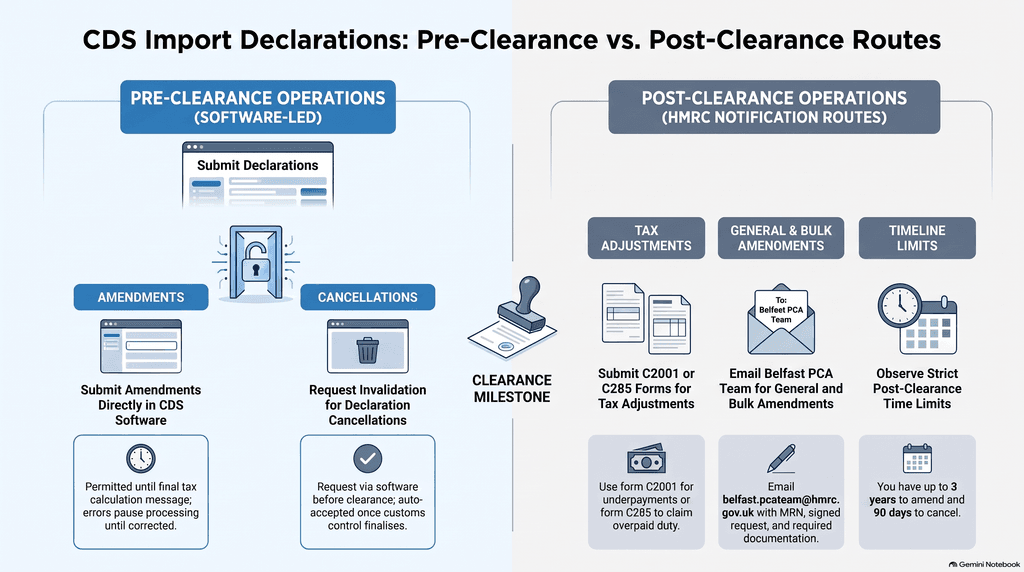
Before goods are cleared, amendments can be submitted directly through your CDS declaration software.
- Timing: You can submit software amendments up until you receive a final tax calculation message from CDS.
- Exceptions: Software amendments are restricted if a claim to quota makes the tax calculation provisional, or if your account balance is insufficient to cover the customs debt.
- Handling Errors: If an amendment submission produces an error message, the declaration is paused. You must submit either a nil amendment (an amendment with no changes) or a new amendment to clear the error.
- Cancellation (Invalidation/Withdrawal): You can request invalidation up until clearance. If goods have not yet arrived, invalidation is straightforward. If the goods have arrived and are under control by HMRC, UK Border Force, or Trading Standards, acceptance depends on the control authority or occurs automatically once control is finalised.
Post-Clearance Amendments and Cancellations
Once goods are cleared, you cannot amend or cancel a declaration using CDS software. Instead, you must notify HMRC directly. All post-clearance requests are reviewed manually by HMRC officers.
- Time Limits: You have up to 3 years from clearance to request an amendment and 90 days to request a cancellation.
- Monetary Adjustments:
- Underpayments: If an error resulted in underpaid duty or VAT, submit Form C2001 (Voluntary Clearance Amendment).
- Overpayments: If you overpaid duty or VAT, apply using Form C285 (Repayment of Import Duty and VAT).
- Non-Monetary and Bulk Amendments: For bulk amendments (moving high volumes of declarations from one importer EORI to another) or standard non-monetary adjustments, email
belfast.pcateam@hmrc.gov.uk. Submissions must include a signed letter/email, Movement Reference Number (MRN) or entry number, detailed explanation, commercial invoices, and any required supervising office approvals. - Exempt Data Elements: Certain technical fields do not require formal HMRC notification if changed after clearance. These include DE 2/1 (Simplified Declaration — Previous Documents), DE 2/4 (Reference Number), DE 4/1 (Delivery Terms), DE 4/13 (Valuation Indicator), and DE 4/16 (Valuation Method). You must update and maintain these in your internal commercial records.
Demystifying Civil Penalties: Rules, Escalations, and Serious Errors
To encourage accurate declarations, UK law empowers HMRC to issue civil penalties for non-compliance under Sections 24 to 41 of the Finance Act 2003 and the Customs (Contravention of a Relevant Rule) Regulations 2003. Unlike civil evasion penalties, customs civil penalties do not imply dishonesty or intent to evade tax.
Warning Letters and Penalty Escalation
For most minor or standard irregularities, HMRC operates a warning system:
- Warning Letter First: HMRC will generally issue a written warning letter detailing the contravention.
- The 2-Year Rule: If you commit a “broadly similar irregularity” within 2 years of that warning letter, HMRC will charge a financial penalty.
- Progressive Penalty Scale: Penalties start at a minimum base rate of £250 and progress through £500, £1,000, £2,000, up to the statutory maximum of £2,500 per contravention for severe or repeated irregularities.
Immediate Penalty Exceptions
HMRC can bypass the warning letter step and issue an immediate penalty notice on a first offence if:
- The error has a serious detrimental effect on revenue or physical control of goods.
- A C18 demand note for a customs debt of £10,000 or more is issued.
- A trader fails to adhere to specific written instructions or guidance previously issued by HMRC.
- A trader breaches formal approval conditions of an authorisation (such as Customs Freight Simplified Procedures – CFSP).
Defining a “Serious Error”
HMRC classifies errors as severe based on specific financial thresholds and operational impacts:
- Incorrect Declarations / CPEI Misuse: Considered serious if the undeclared Customs Duty and/or import VAT exceeds £10,000.
- Delayed Declarations (CFSP / Inward Processing): Considered serious if the tax liability falls into a later period and exceeds £25,000.
- Physical Control Breaches: Removing goods from customs control without authorisation is treated as a serious error regardless of monetary value.
- High-Value Escalators: If undeclared duty/VAT exceeds £50,000, HMRC may jump the penalty calculation 2 steps higher (e.g., charging £1,000 as a first penalty). If under-declarations exceed £100,000, HMRC may impose the maximum £2,500 penalty immediately.
Building Your Defence: Voluntary Disclosures, Reasonable Excuse, and Mitigation
When a contravention occurs, traders have several statutory defences and administrative avenues to minimise or eliminate financial penalties.
Unprompted Voluntary Disclosures
You will not receive a civil penalty if you discover and voluntarily disclose an error yourself. To qualify as a voluntary disclosure:
- It must be made in writing (via forms like C2001, C285, or the Digital Disclosure Service).
- It must be submitted at a time when you had no reason to believe HMRC had commenced enquiries or investigations into your customs affairs.
Establishing a “Reasonable Excuse”
If HMRC or an independent tax tribunal agrees that you have a reasonable excuse for non-compliance, you will not be liable to a penalty. A reasonable excuse is an unexpected or unusual event beyond your control that prevented compliance despite taking reasonable care.
- Valid Examples:
- Compassionate circumstances (e.g., serious illness of a sole trader or immediate family member).
- Critical computer outage holding essential records at a critical deadline, provided immediate steps were taken to fix it.
- Sudden loss of key personnel responsible for customs declarations with no immediate replacement available.
- Theft or destruction of business records, reported immediately to HMRC.
- Statutory Exclusions (What is NOT a Reasonable Excuse):
- Inability to pay or insufficiency of funds to cover duties or penalties.
- Reliance on a third party (e.g., blaming your customs broker or freight forwarder for the mistake).
- Acting in good faith, honesty, or making a “genuine mistake.”
Discretionary Mitigation (CCPG11820)
Where no reasonable excuse exists, HMRC compliance officers have legal discretion to mitigate (reduce) penalty amounts based on individual circumstances.
- Recognised Mitigating Factors:
- A demonstrably good previous compliance history (e.g., up to 10% reduction).
- Active cooperation in identifying and quantifying under-declarations.
- Prompt remedial action taken to fix systems and prevent repeat errors (e.g., up to 30% reduction).
- Mandatory Non-Mitigating Factors: By law, officers cannot reduce penalties due to lack of funds, cash flow problems, the fact that no tax was lost, or that the trader acted in good faith.
Practical Mitigation Example:
- Starting Penalty Base: £250
- Mitigation Allowed: Good compliance history (10%) + Remedial action taken (30%) = 40% Total Mitigation
- Calculation: 40% of £250 = £100 reduction.
- Final Payable Penalty: £250 – £100 = £150.
Supply Chain Governance: Due Diligence, Agent Roles, and Regulatory Updates
Ultimate legal liability for customs declarations rests with the importer or business owner, making proactive supply chain governance essential.
Responsibilities of Customs Representatives
Traders often hire third-party customs agents, brokers, or freight forwarders. The representation type determines legal liability:
- Direct Representation: The agent acts in your name. You (the trader) remain solely liable for all customs debts and misdeclaration penalties.
- Indirect Representation: The agent acts in their own name on your behalf. The agent and importer become jointly and severally liable for all customs debts.
- UK Establishment Rule: If a business is not established in the UK, a customs agent can only represent them in an indirect capacity, sharing full liability.
Spotting Supply Chain Fraud
Traders and agents must perform due diligence to ensure supply chains are not used for tax evasion or fraud. Be cautious if trading partners show red flags such as:
- Newly incorporated companies with no trading history or industry background.
- Unsolicited offers promising easy profits on high-value, high-volume goods.
- Requests for cash-only payments or third-party/offshore bank transfers.
- Sale prices so far below market rates that they appear commercially unviable.
- Unwillingness to accommodate face-to-face meetings or facility visits.
Essential Verification Checks
- VAT Registration: Validate UK VAT numbers using HMRC’s online checker and EU VAT numbers via the VIES (VAT Information Exchange System).
- EORI Numbers: Verify Economic Operators Registration and Identification (EORI) numbers starting with ‘GB’ using the online EORI tracker.
- Deferment Approvals: Obtain explicit written authority before using a trader’s or client’s Duty Deferment Account.
Regulatory Updates: 2025 Regulations
Under The Customs (Miscellaneous Amendments) Regulations 2025 (effective July 2025), key rules were updated:
- Foreign Postal Operators: Created a new authorisation framework requiring foreign postal operators in Great Britain to register and meet due diligence standards.
- Temporary Admission: Extended the period certain goods (such as works of art, collectors’ items, and antiques) can stay in the UK under temporary admission relief from 24 months up to 48 months.
- Enforcement Powers & Penalties: Clarified HMRC powers to inspect goods in Northern Ireland and introduced penalties up to £1,000 for failing to comply with customs directions regarding the movement or examination of goods under CEMA 1979.
🌐 Find customs agents & compliance experts:https://customsdirectory.com/
Summary
Maintaining accurate customs declarations requires proactive management, thorough due diligence, and prompt corrective action when errors occur. Additionally, understanding HMRC’s penalty structures and post-clearance correction tools ensures businesses remain compliant while protecting themselves from unexpected liabilities.
Key Takeaways
- Pre vs. Post Clearance: Pre-clearance changes are handled via CDS software; post-clearance changes require formal manual forms (C2001 for underpayments, C285 for overpayments) within 3 years for amendments and 90 days for cancellations.
- Civil Penalty Framework: Penalties range from £250 to £2,500 per contravention under the Finance Act 2003. HMRC usually issues a warning letter valid for 2 years unless serious error thresholds (£10k+ underdeclaration, £25k+ CFSP delay, physical control breach) or C18 debt demands apply.
- Voluntary Disclosures: Unprompted written disclosures made before HMRC starts an enquiry eliminate penalties.
- Reasonable Excuse vs. Mitigation: Lack of funds, reliance on agents, and good faith are not valid reasonable excuses or statutory grounds for mitigation under UK law.
- Agent Representation: Direct representation leaves the importer solely liable, while indirect representation creates joint liability between the trader and agent.
Amend or cancel a Customs Declaration Service import declaration
Returned Goods Relief for Repaired Goods
https://www.youtube.com/watch?v=_FZHzXRJbUA
FAQ
What are the primary differences between amending or cancelling a CDS import declaration before clearance versus after clearance?
Prior to clearance, amendments to CDS import declarations can be made via software up until receiving a final tax calculation, while cancellations (invalidations) are requested electronically. Post-clearance, declarations cannot be altered directly in CDS; instead, traders must notify HMRC in writing, having up to 3 years to request amendments and 90 days to request cancellations. All post-clearance requests are subject to HMRC review and specific notification processes based on whether tax overpayments or underpayments resulted.
Under what specific circumstances may HMRC issue a penalty notice for a first-time customs contravention without first issuing a warning letter?
HMRC may issue an immediate penalty notice for a first contravention if the error is serious and causes significant harm to revenue or physical control of goods, or if a C18 demand note for a customs debt equals £10,000 or more. First-time penalties are also applied if traders fail to adhere to written instructions given by HMRC or breach specific conditions of an authorization. In these defined instances, the standard prerequisite of issuing a warning letter within the prior two years is bypassed.
What distinguishes a direct customs representative from an indirect customs representative regarding UK establishment and legal liability?
A direct customs representative acts on behalf of a UK-established trader, meaning the trader retains primary liability for customs debts and accurate declarations. Conversely, if a business is not established in the UK, it must appoint a representative in an indirect capacity. Under indirect representation, the representative and the non-UK trader become jointly and severally liable for all incurred customs debts and compliance obligations.
According to HMRC guidance, how is a “serious error” defined in terms of monetary thresholds and operational impacts?
A serious error includes any contravention involving incorrect declarations, unauthorized use of CPEI, or delayed declarations where the potential non-payment of Customs Duty and import VAT exceeds £10,000 (or £25,000 for certain delayed CFSP/inward processing declarations). Additionally, any error that results in goods being improperly removed from customs control or harms the physical control of goods is classified as a serious error regardless of monetary value. These severe classifications can trigger individual penalties per contravention or immediate penalty charges.
What are the key time limits and statutory rules governing look-back periods for voluntary disclosures using the Digital Disclosure Service (DDS) based on taxpayer behavior?
The look-back period for tax disclosures via the DDS depends on taxpayer behavior: 4 years if reasonable care was taken, 6 years for careless behavior, and up to 20 years for deliberate misleading or failure to notify. If the lost tax involves an offshore matter, a maximum look-back period of 12 years applies for inaccuracies arising from reasonable care (from 2015–16) or carelessness (from 2013–14). Disclosures must be formally submitted and paid within 90 days of receiving a notification acknowledgement from HMRC.
What specific conditions and statutory exclusions apply when a trader seeks to claim a “reasonable excuse” for a customs law contravention?
A reasonable excuse requires an unexpected or unforeseeable event beyond the trader’s control, such as a severe illness, computer system crash, loss of key personnel, or stolen records, provided reasonable care was taken. However, the law explicitly dictates that an inability to pay duties/penalties or reliance on a third party whose conduct caused the error cannot be cited as a reasonable excuse. Mistake, honesty, or acting in good faith also fail to satisfy the legal standard for a reasonable excuse.
How does HMRC calculate monetary penalty escalations for severe or repeated underdeclarations, and how can penalty amounts be mitigated?
Base penalties progress from £250 for initial errors to £500, £1,000, £2,000, and up to £2,500, though underdeclarations over £50,000 jump two rate steps and those exceeding £100,000 attract the maximum penalty immediately. HMRC officers hold discretionary power to mitigate penalties based on factors like a good compliance history, assistance in quantifying under-declarations, and prompt remedial action. However, mitigation percentages cannot be based on cash flow problems, lack of revenue loss, or good faith, and sympathy cannot form the basis of a reduction.
What key changes to the Temporary Admission procedure and Common Transit procedure were introduced by The Customs (Miscellaneous Amendments) Regulations 2025?
The 2025 Regulations permit works of art, collectors’ items, and antiques to be held under temporary admission for up to 48 months and allow HMRC to extend other goods beyond 24 months. For transit procedures, the regulations abolish paper-based transit arrangements for air and rail freight while introducing a new simplification allowing declarations with reduced data requirements. They also establish an authorization framework for foreign postal operators and introduce civil penalties up to £1,000 for breaching customs movement or examination rules.
What process must a trader follow to make a valid voluntary disclosure of a customs underdeclaration to ensure they avoid penalties?
To qualify as a voluntary disclosure, a trader must notify HMRC in writing before having any reason to believe HMRC is conducting enquiries into their customs activities. Depending on whether an underpayment, overpayment, or non-monetary error occurred, notifications and supporting records must be submitted to specific HMRC units like the C18 Team or CFSP National Assurance Team. Traders must maintain meticulous records of all disclosure actions, calculations, and correspondence to avoid civil penalty charges.
According to research by Barbourne Brook, what is the average broker error rate in customs declarations, and what are the financial risks faced by businesses during an HMRC post-clearance audit?
Barbourne Brook’s analysis of over 600,000 customs transactions revealed an average broker error rate of approximately 34%, meaning roughly one in three declarations contains inaccuracies. During a retrospective three-year audit window, HMRC can claw back underpaid duties and impose civil penalties of up to £2,500 per incorrect declaration or up to the full underpaid duty amount. These substantial financial exposures, combined with risks of goods being delayed or seized, underscore the necessity for Financial Directors to conduct rigorous post-clearance checks.
Comments